
10 Jun The Power of Presence: How Mindfulness In Sports Reduces Stress and Improves Performance
In the high-stakes world of competitive sports, the difference between a gold medal and an early exit rarely comes down to physical conditioning alone. At the elite level, athletes possess remarkably similar physical capabilities, training regimens, and nutritional strategies. What truly separates the good from the great is the theatre of the mind. When pressure mounts, seconds tick away, and thousands of fans roar from the stands, an athlete’s internal landscape becomes the ultimate deciding factor.
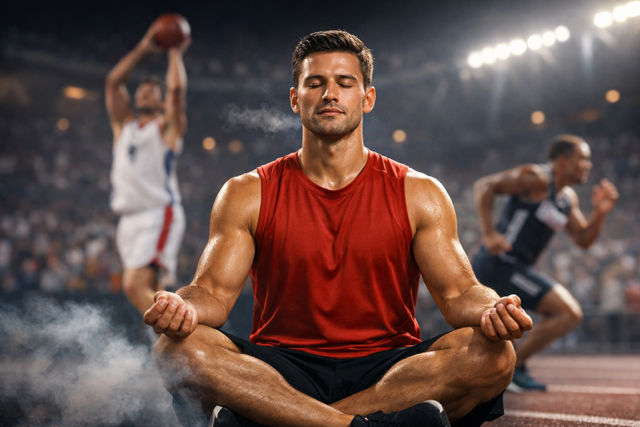
For decades, sports psychology focused heavily on traditional mental toughness, which often meant forcing positive thinking or aggressively suppressing anxiety. Today, a paradigm shift is occurring. Athletes, coaches, and sports scientists are turning to mindfulness, the practice of maintaining a moment-by-moment awareness of our thoughts, feelings, bodily sensations, and surrounding environment through a gentle, nurturing lens.
By training the brain to anchor itself in the present moment, athletes can effectively dismantle performance anxiety, sharpen their focus, and unlock new levels of athletic excellence.
1. The Physiology of Stress and Performance Anxiety
To understand how mindfulness transforms athletic execution, one must first examine what happens to the body under intense competitive stress. When an athlete views a game, a race, or a specific play as a threat rather than a challenge, the brain triggers the sympathetic nervous system. This is the classic fight or flight response.
While a baseline level of arousal is necessary for athletic performance, an overactive stress response is catastrophic for fine motor skills.
- Muscle Tension: Stress causes muscles to constrict automatically. Fluidity is replaced by rigidity, disrupting the mechanical precision required for a golf swing, a basketball free throw, or a gymnastics routine.
- Tunnel Vision and Cognitive Overload: The brain becomes hyper-focused on potential negative outcomes. Instead of reading the field organically, the athlete is paralysed by analytical thoughts, a phenomenon widely known as “paralysis by analysis.”
- Cortisol and Adrenaline Spikes: An excess of these hormones accelerates the heart rate past the optimal zone for decision making, depleting the athlete’s energy reserves long before the competition ends.
Mindfulness acts as an immediate physiological counterweight. By practicing mindful breathing and body scans, athletes activate the parasympathetic nervous system, which lowers the heart rate, restores optimal blood flow, and relaxes constricted muscle groups. Instead of fighting the stress, mindfulness teaches athletes to acknowledge the physiological symptoms without judgment, preventing a minor spike in adrenaline from snowballing into a full-blown competitive panic.
2. Breaking the Cycle of Negative Rumination
One of the greatest enemies of peak athletic performance is the wandering mind. During a game, an athlete might drop a pass, miss an easy shot, or receive an unfair call from a referee. For a non-mindful athlete, this single mistake triggers a cascade of negative internal commentary. They begin agonising over the past error or projecting catastrophic future scenarios, such as losing the match or disappointing their coach.
Mindfulness trains the brain in the art of cognitive defusion. This is the ability to observe thoughts as temporary, passing mental events rather than absolute truths. When a mindful athlete makes a mistake, they notice the frustration arise, accept its presence, and immediately return their attention to the next play.
This psychological resilience is essential for maintaining consistency. In communities focused on youth development and holistic health, such as families working with organisations like ssdsoakville, introducing these mental habits early can reshape how young people handle failure, teaching them that a mistake is simply data, not a definition of their worth.
By eliminating the cognitive friction of self-criticism, athletes preserve valuable mental energy. They stop playing the role of the internal critic and instead become the objective observer, allowing their muscle memory and instincts to dictate their movements.
3. Entering the Flow State: The Ultimate Athletic Peak
In sports psychology, the “flow state,” often referred to as being in the zone, represents the absolute pinnacle of human performance. Characterised by psychologist Mihaly Csikszentmihalyi, flow is a state of complete immersion in an activity. In this state, time seems to warp, self-consciousness vanishes, and execution feels entirely effortless.
Mindfulness is the direct behavioural pathway to entering this elusive state. Flow requires a perfect alignment of challenge and skill, paired with total concentration on the present task. If an athlete’s mind is divided between the mechanics of their body and the score on the scoreboard, flow becomes impossible to achieve.
Mindful Awareness ──> Reduced Cognitive Friction ──> Deep Present Focus ──> The Flow State
When an athlete practices mindfulness consistently, they develop a heightened sense of interoception, which is the internal perception of bodily sensations. They become acutely aware of their balance, their centre of gravity, and the precise rhythm of their movement. This deep sensory connection grounds them so thoroughly in the immediate physical reality that the critical, analytical mind goes quiet. With the ego temporarily sidelined, the body can perform exactly as it was trained to do, leading to those breathtaking, intuitive plays that define sports history.
4. Practical Mindfulness Techniques for Daily Training
Mindfulness is not a vague, abstract philosophy; it is a concrete skill that must be trained just like a cardiovascular system or a specific set of muscles. Athletes can integrate several structured practices into their daily routines to build this mental muscle.
Mindful Breathing (The Anchor)
Before stepping onto the field or during breaks in play, athletes can utilise box breathing or focused abdominal breathing. By counting the length of the inhale, the pause, and the exhale, the athlete provides the mind with a singular point of focus. This simple act pulls the consciousness away from external distractions and anchors it squarely in the physical body.
Pre-Performance Rituals
Instead of mindlessly tying shoes or checking equipment, athletes can transform these actions into deliberate mindfulness triggers. Paying close attention to the texture of the laces, the sound of the velcro, or the feeling of the grass beneath their cleats helps narrow their focus, signalling to the brain that it is time to transition from daily life into a state of competitive presence.
Objective Post-Game Review
Rather than evaluating a performance through the emotional lens of shame or pride, a mindful review treats every video session as an objective science experiment. The athlete observes what went well and what requires adjustment, completely decoupling their self-esteem from the statistical outcome of the event.
Conclusion: The New Frontier of Athletic Excellence
The evolution of modern sports has proven that physical training, strategic preparation, and nutritional science can only take an athlete so far. When the playing field is level physically, the ultimate competitive advantage belongs to the individual who controls their own mind.
Mindfulness in sports is not about eliminating pressure, nor is it about pretending that stress does not exist. It is about altering your relationship with that pressure. By learning to sit comfortably with anxiety, dismiss negative rumination, and anchor the awareness entirely in the present moment, athletes can systematically reduce stress and dramatically improve their performance.